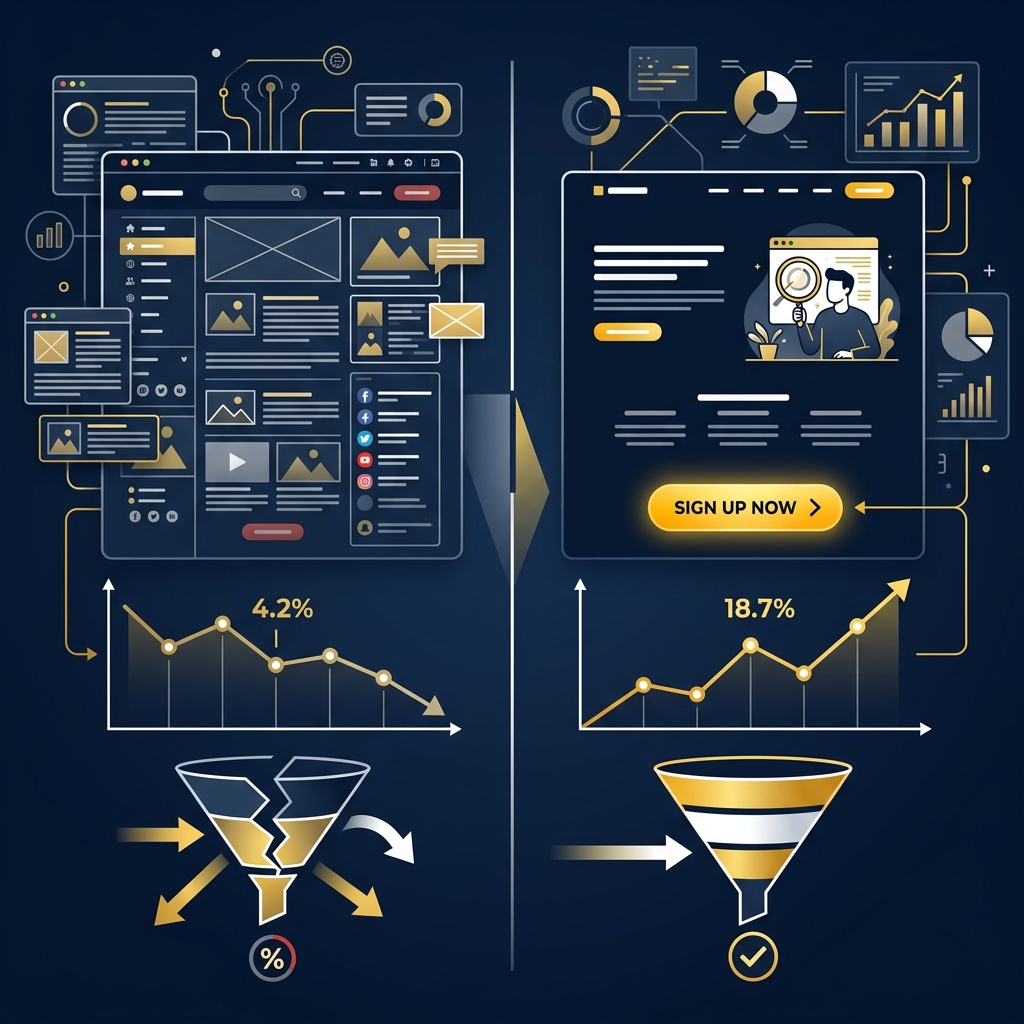
A landing page is a standalone web page built for a single, focused conversion goal. Unlike a homepage, which serves multiple audiences and purposes, a landing page strips away navigation, distractions, and competing calls-to-action so that visitors take one specific action.
A landing page is a single-purpose web page designed to convert visitors into leads or customers. It differs from a homepage by removing navigation and distractions. Businesses that send paid traffic to dedicated landing pages instead of homepages typically see significantly higher conversion rates and lower cost-per-acquisition.
What Is the Purpose of a Landing Page?
The purpose of a landing page is to guide a visitor toward one specific action, such as filling out a form, making a purchase, or booking a call.
Homepages are built for exploration. They contain navigation menus, multiple sections, links to blog posts, about pages, and service overviews. A landing page does the opposite: it gives visitors a single path forward. Every headline, image, and button reinforces the same goal.
The most effective landing pages have exactly one call-to-action. Research from WordStream found that landing pages with multiple offers get 266% fewer leads than those with a single offer.
How Is a Landing Page Different From a Homepage?
A landing page differs from a homepage in structure, intent, and performance. While a homepage introduces a brand and encourages browsing, a landing page is built to convert traffic from a specific source.
| Feature | Landing Page | Homepage |
|---|---|---|
| Primary Goal | Single conversion (lead, sale, signup) | Brand introduction and navigation |
| Navigation Menu | Removed or minimized | Full menu with multiple links |
| Number of CTAs | One focused call-to-action | Multiple CTAs across sections |
| Traffic Source | Paid ads, email, social campaigns | Organic search, direct, referrals |
| Content Focus | Single offer or message | Overview of products and company |
| Conversion Rate | Higher — focused intent | Lower — general exploration |
When a visitor clicks a Google ad or Facebook campaign, they arrive with a specific expectation. A homepage forces them to figure out where to go next. A landing page meets them exactly where they are.
Why Do Homepages Convert Poorly for Paid Traffic?
Homepages convert poorly for paid traffic because they introduce decision fatigue and competing paths before a visitor has committed to any action.
A visitor who clicks an ad promising "Free Website Audit" does not want to read about company history, browse service categories, or explore the blog. They want the audit. Every extra link, menu item, or secondary message gives them a reason to leave.
Sending paid traffic to a homepage often produces bounce rates above 70%. That means seven out of ten paid clicks leave without interacting — and those clicks still cost money.
Businesses that treat their homepage as a landing page typically see cost-per-lead increases of 50% or more compared to campaigns using dedicated landing pages.
What Elements Should a High-Converting Landing Page Include?
A high-converting landing page includes a clear headline, a compelling offer, supporting proof, and a single, visible call-to-action.
According to Unbounce, the average landing page conversion rate across industries is 4.02%, but pages that follow established best practices often achieve rates of 10% or higher. The core elements include:
- Headline that matches the ad: If the ad promised a free consultation, the headline should say "Get Your Free Consultation" — not something generic.
- Subheadline with clarity: One sentence that explains what the visitor gets and why it matters.
- Social proof: Testimonials, case results, or trust badges reduce perceived risk.
- Single form or CTA button: Multiple forms or buttons create confusion and lower conversions.
- Mobile optimization: Over 60% of landing page traffic comes from mobile devices. Pages that are not mobile-responsive lose conversions immediately.
A poorly structured website — including one that lacks dedicated landing pages — can also suffer from underlying technical and content issues. For a deeper look at why sites underperform in search and conversion, see why your website isn't ranking and what to fix first.
When Should a Business Use a Landing Page Instead of a Homepage?
A business should use a landing page instead of a homepage whenever the traffic comes from a paid or targeted source with a specific offer or campaign goal.
Common scenarios include:
- Google Ads campaigns: Each ad group should point to a page matching the search intent.
- Facebook or Instagram ads: Social traffic has low patience; landing pages reduce friction.
- Email marketing: Promotional emails perform better with dedicated pages that repeat the email's message.
- Webinar or event signups: A focused page outperforms a general "Contact Us" flow.
- Product launches: New offerings need pages built around their unique value, not buried in a site menu.
The rule is simple: if money was spent to bring the visitor to the page, the page should be built to convert that visitor — not to introduce the brand.
A landing page is not a smaller homepage. It is a different tool with a different job. Homepages serve broad audiences. Landing pages serve single intentions. Small businesses running paid advertising without dedicated landing pages are typically spending more to acquire each lead than competitors who do. The investment required to build landing pages is far lower than the cost of wasted ad spend.

Written by Matthew Macias
Operations Director & Co-founder of Macias & Skelnik Marketing LLC. Matthew specializes in web design, SEO, lead generation, and building marketing systems that generate real results for small businesses in Orange County and beyond.
Need a Landing Page That Actually Converts?
Macias & Skelnik Marketing builds conversion-optimized landing pages for small businesses in Orange County. Get a free consultation.
Get a Free Consultation