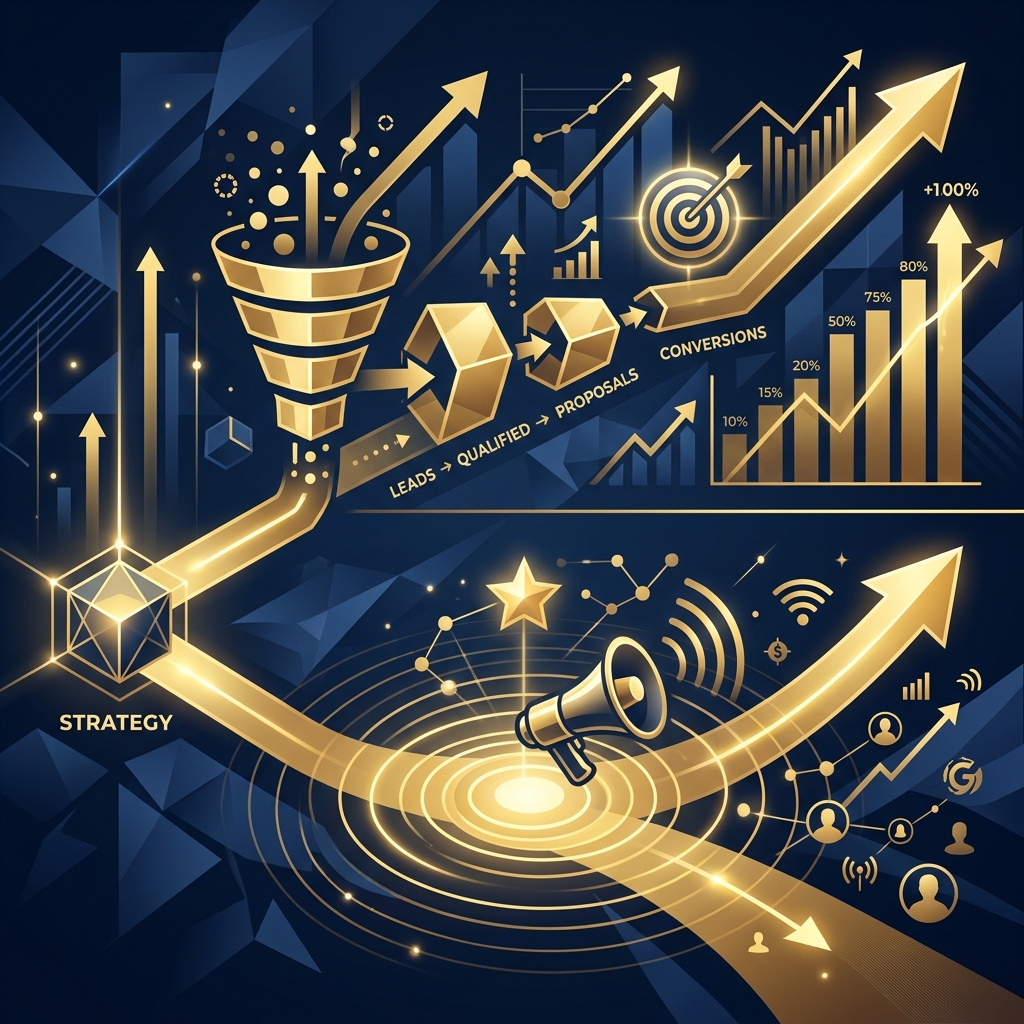
Small businesses with limited budgets should prioritize lead generation first. Brand awareness becomes a sustainable investment only after predictable revenue and customer acquisition costs are under control.
Lead generation delivers immediate, measurable revenue and should be the first priority for small businesses. Brand awareness builds long-term trust and lowers future acquisition costs, making it best for businesses with stable cash flow. Most small companies need both — but lead generation comes first.
What Is Lead Generation?
Lead generation is the process of attracting and converting strangers into prospects who have expressed interest in a product or service. It focuses on capturing contact information and moving potential customers into a sales pipeline.
Common lead generation tactics include search engine optimization, pay-per-click advertising, content marketing with gated downloads, and email capture forms. These methods produce measurable outcomes: form submissions, phone calls, and direct purchases.
For small businesses, lead generation offers a direct return on investment. Every dollar spent can be traced to a specific inquiry or sale, making it easier to justify marketing expenses and iterate quickly on what works.
What Is Brand Awareness?
Brand awareness is the extent to which consumers recognize and recall a particular brand. It measures how familiar a target audience is with a company's name, logo, values, and market position.
Brand awareness campaigns typically use display advertising, social media presence, public relations, sponsorships, and content that emphasizes values over direct selling. These efforts rarely produce immediate conversions.
Strong brand awareness reduces friction in future sales conversations. When prospects already recognize and trust a brand, they are more likely to choose it over unknown competitors — and more likely to pay a premium.
Which One Produces Faster Results?
Lead generation produces faster, more predictable results than brand awareness. A well-optimized Google Ads campaign or landing page can generate inquiries within days of launch.
Brand awareness, by contrast, compounds over months or years. A 2023 Nielsen study found that 59% of consumers prefer to buy from brands they recognize, but building that recognition requires sustained exposure and significant media spend before any measurable revenue lift appears.
Small businesses operating on thin margins cannot afford to wait 6 to 12 months for brand campaigns to mature. Lead generation provides the cash flow necessary to survive early stage and fund future brand investment.
Brand awareness is an investment in future demand. Lead generation is a tool for present survival. Both matter — but timing determines priority.
How Do Costs Compare Between Lead Generation and Brand Awareness?
Lead generation campaigns usually operate on performance-based pricing models, where businesses pay per click, per lead, or per acquisition. Costs are immediate and directly tied to results.
Brand awareness campaigns often require broad-reach media buys — display advertising, social reach, or sponsorships — that charge for impressions regardless of conversion. These campaigns demand larger budgets and longer runways before efficiency improves.
| Factor | Lead Generation | Brand Awareness |
|---|---|---|
| Time to first result | Days to weeks | Months to years |
| Cost structure | Pay-per-lead or acquisition | Pay-per-impression or reach |
| Measurability | High — conversions tracked | Low — surveys, recall tests |
| Best business stage | Startup and growth phase | Stable, mature revenue |
| Risk if stopped early | Revenue stops immediately | Some residual recognition remains |
Can a Small Business Run Both Strategies at Once?
Yes, but only if the budget and operations can support parallel efforts without diluting either. Attempting to split limited resources often produces mediocre results in both categories.
A more practical approach is sequential integration. A small business can begin with lead generation to establish revenue and customer data. Once unit economics are proven, a portion of profits can fund brand awareness initiatives that reduce future lead costs.
For example, a local service company might start with Google Local Services Ads to generate phone leads. After six months of profitable campaigns, it can reinvest margin into community sponsorships and organic social content to build regional name recognition.
Running brand awareness campaigns without a functioning sales process or lead follow-up system wastes budget. Awareness creates interest — but only infrastructure converts it into revenue.
What Role Does the Website Play in This Decision?
The website is the central infrastructure for both strategies, but it serves different functions in each. For lead generation, the website acts as a conversion engine with clear calls to action, fast load times, and optimized landing pages.
For brand awareness, the website reinforces identity through storytelling, design consistency, and educational content — becoming a destination for people who encountered the brand elsewhere.
If a website fails to convert traffic into leads, increasing brand awareness only amplifies the leak. Businesses struggling with low conversion rates should address site performance before scaling either strategy. For a breakdown of the most common structural problems, see why your website isn't ranking on Google.
When Should Brand Awareness Become the Priority?
Brand awareness should take priority when a business has reached revenue stability, proven customer lifetime value, and wants to reduce dependency on paid acquisition channels.
At this stage, the business has already validated its offer and knows its ideal customer profile. Brand awareness then serves as a multiplier: it lowers cost per lead, improves close rates, and creates defensible market position against competitors who are still fighting for attention at the bottom of the funnel.
Companies that skip lead generation and jump straight to brand building often run out of capital before awareness translates into sales. The sequence matters more than the individual tactics.
Lead generation and brand awareness are not competing strategies — they are sequential priorities. Small businesses should start with lead generation to generate revenue, prove their model, and fund future growth. Once stable, brand awareness becomes the most efficient way to reduce acquisition costs and build long-term enterprise value. The businesses that scale successfully treat marketing as a staged system, not a single bet.

Written by Matthew Macias
Operations Director & Co-founder of Macias & Skelnik Marketing LLC. Matthew specializes in web design, SEO, lead generation, and building marketing systems that generate real results for small businesses in Orange County and beyond.
Ready to Build a Lead Generation System That Works?
Macias & Skelnik Marketing builds lead generation systems for small businesses in Orange County. Get a free consultation and find out what strategy fits your stage.
Get a Free Consultation